On this page
A walking harness is worth buying when it fits the dog’s body and the handler’s walking arrangement. A higher fee, more buckles or a front leash ring does not guarantee that a dog will stop pulling. The purchase supplies equipment; training and comfortable handling remain separate parts of walking together.
The prices and dimensions here come from Ruffwear and Blue-9’s own listings checked in October 2026. They compare two named new products, not every harness or a national average. The fit details refer to each manufacturer’s system and should not be transferred between brands just because the size labels match.
Key figures
- $59.99 Ruffwear Front Range walking harness
- $39.95 Blue-9 Balance walking harness
The two published prices differ by $20.04
Ruffwear lists the new Front Range harness at $59.99. Blue-9 lists Balance at $39.95. Subtracting the prices gives $20.04, or about 33.4% of the Ruffwear price. That difference is a checkout comparison, not a quantified difference in comfort, control or durability.
| Published walking-harness feature | Ruffwear Front Range | Blue-9 Balance |
|---|---|---|
| New product price | $59.99 | $39.95 |
| Adjustment points | 4 | 6 |
| Leash attachments | Back aluminum V-ring and reinforced front webbing | Front and back rings |
| Neck arrangement | Consult the model’s fitting instructions | Neck buckle described by manufacturer |
| Product-price difference | $20.04 above Balance | $20.04 below Front Range |
Source note: The manufacturers’ product descriptions and current new-item prices, checked in October 2026. Adjustment counts and attachment designs are product specifications; they do not establish a guaranteed training outcome.
Ruffwear’s public catalog also contains lower-priced used-condition variants. Those are not the new $59.99 product comparison in this table. A used price should be labeled with its condition and availability rather than quoted as the ordinary new-item fee.
Color stock and size availability can change what can be ordered. Check the variant, condition and exchange policy before comparing checkout totals. A discount on an unavailable size does not lower the cost of a fitting harness that the household can buy.
Girth measurements are more precise than size names
Ruffwear’s Front Range chart specifies measurement around the widest part of the rib cage. Its girth bands are XXS at 13–17 inches, XS at 17–22 inches, Small at 22–27 inches, Medium at 27–32 inches and L/XL at 32–42 inches. The overlap at boundaries is a reason to follow its fitting guidance and check adjustment, not to choose randomly.
The manufacturer advises sizing up when between sizes. That direction belongs to this chart; it does not establish that every brand’s larger size is safer or less likely to slip. Check the dog’s body shape and the positioning of straps once the fitting size is tried.
A hypothetical dog measuring 24 inches around the stated location falls inside Ruffwear’s Small band. A measurement of 30 inches falls inside Medium. These examples demonstrate reading the chart; they do not select a harness for a dog whose shape, behavior or measurement technique has not been checked.
Blue-9’s Balance has its own measurement and adjustment guidance. Do not use the Ruffwear Small band to order a Blue-9 Small without checking Blue-9’s chart. Weight estimates and breed names are rough descriptions, whereas the seller’s measurements define the size being purchased.
More adjustments can help fit but add setup work
Four or six adjustment points allow changes to different straps, but the count does not show whether the dog can move comfortably or whether the handler can set them correctly. Ask which straps change and how the manufacturer expects them to sit relative to the neck, shoulders and rib cage.
The Balance’s neck buckle can matter to an owner whose dog dislikes having equipment passed over its head. That feature still needs a gradual introduction and secure closure. A convenient buckle does not establish that the product is suitable for every handling problem.
Examine fit with the dog standing and moving normally. Follow the manufacturer’s instructions rather than a generic finger-width rule treated as universal. Check that straps remain in their instructed position without rubbing or restricting movement and that the dog cannot simply back out of the arrangement.
The car-harness cost guide addresses a separate use. Front and back leash rings on a walking product do not establish vehicle crash performance. Do not convert a walking-harness price into a claim about travel restraint by adding a generic tether.
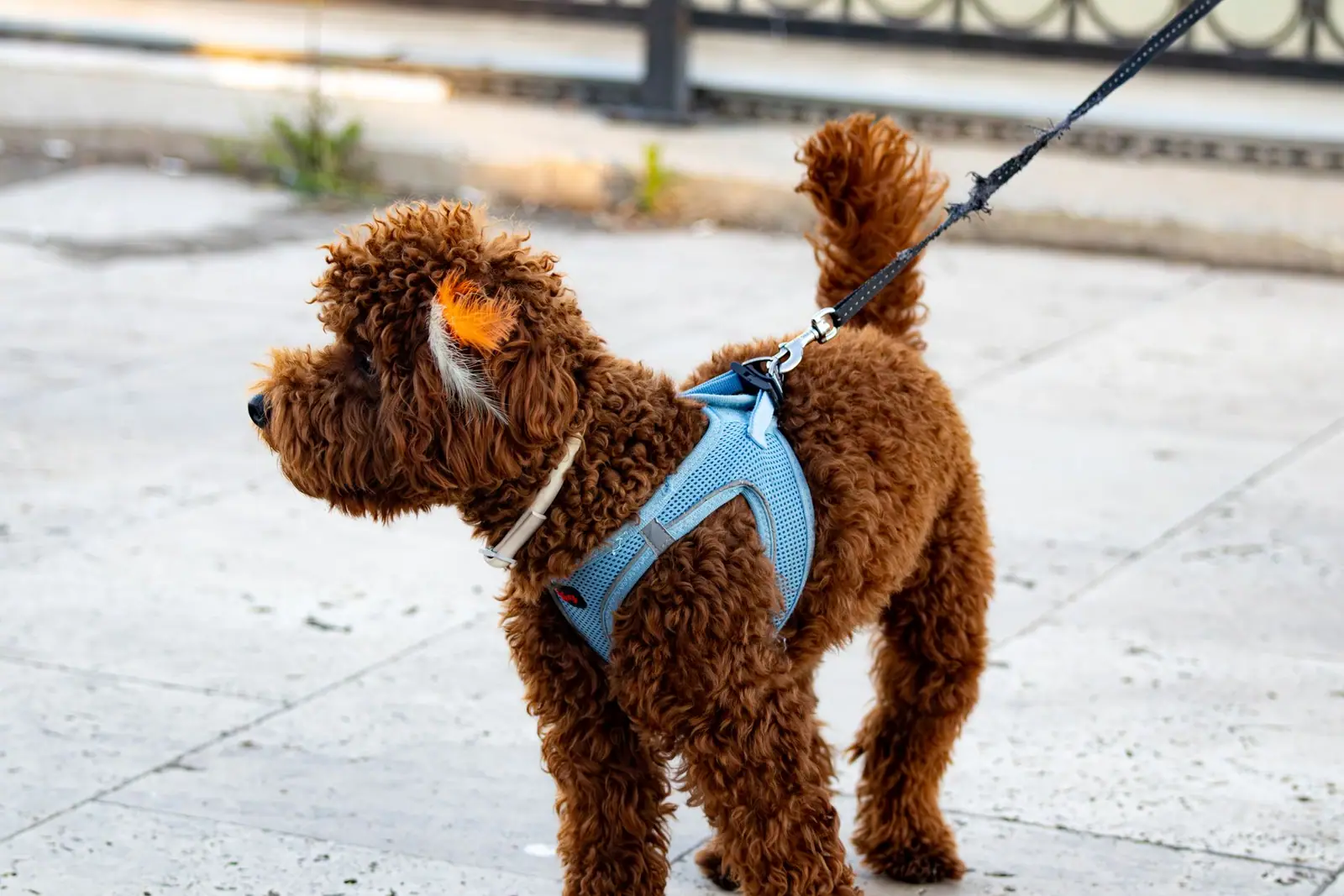
The first walking setup can include supplies already owned
For a hypothetical shopping plan, add a $15 leash and a $3 supply of bags to the $39.95 Balance. The subtotal is $57.95. The same assumed supplies with the $59.99 Front Range total $77.99. Only the harness fees are the published prices; the leash and bags are example inputs.
If the household already owns a compatible leash and bags, those additions are not new purchases. Buying duplicate equipment because it appears in a starter list can erase much of the $20.04 difference. Confirm the connection and handling plan before purchasing accessories.
Shipping, tax and exchanges also affect the total. For example, an assumed $8 return-shipping cost followed by another $8 delivery would add $16 to a failed-size purchase. That is a budgeting scenario, not either brand’s stated return fee. Check the seller’s terms and measurements to reduce avoidable reordering.
The dog-walker service guide explains another reason to clarify equipment before buying. A walker may need to understand the fit and attachment routine, but a new harness is not automatically required with every service booking.
Training determines what happens beyond the attachment
AVSAB’s humane-training statement recommends reward-based methods. Ask an instructor how the harness and leash connection fit the training plan, how pulling is addressed and what to do when the dog becomes afraid or distracted. A marketing phrase about pulling is not a guaranteed result.
The basic-class price guide lists a $149 six-week group-course example. Adding that published course price to the $39.95 harness gives $188.95 before travel or other supplies. With the $59.99 harness, the same subtotal is $208.99. Those combine separate products for planning, not a joint package or a promise that one class resolves every concern.
Equipment can be introduced gradually during quiet practice. Allow time to learn the buckle routine and reward comfortable participation. Repeatedly buying more expensive harnesses without checking fit or handling can increase spending while leaving the walking problem unchanged.
Ask the veterinary team about pain, skin irritation or a sudden change in movement, and seek reward-based behavior support for significant fear or handling difficulty. A front attachment or extra adjustment point is not a substitute for resolving those concerns.
Record the purchased size, fitted measurements and condition so the next replacement is easier to compare. Inspect equipment as the manufacturer directs and replace damaged parts through an approved route. A published product price does not establish a guaranteed replacement interval; wear depends on use and care.
Questions people ask
What do the compared new harnesses cost?
The checked Front Range lists $59.99 and Balance lists $39.95, a $20.04 difference before checkout charges. Lower used-condition listings are a different purchase.
Where does Ruffwear say to measure girth?
Around the widest part of the rib cage. The Front Range chart ranges from 13–17 inches in XXS to 32–42 inches in L/XL; follow the brand's fitting instructions and check the dog in motion.
Do six adjustment points guarantee better fit?
No. They offer more adjustment positions, but the geometry, strap placement and the dog's movement determine whether the harness fits. Compare instructions and try the arrangement.
Will a front leash attachment stop pulling?
It is an equipment feature, not a guaranteed behavior outcome. Combine a comfortable fit with reward-based instruction and a handling plan the dog and owner can follow.
Where these figures come from
- Front Range Harness: Current Price, Fit Chart and Features Ruffwear · ruffwear.com
- Balance Harness: Current Price and Adjustment Features Blue-9 Pet Products · blue-9.com
- Humane Dog Training Position Statement American Veterinary Society of Animal Behavior · avsab.org
Figures last checked October 2026.