On this page
An automatic litter box is primarily a purchase of convenience. It separates waste after use, reducing routine scooping, but it still needs litter, waste disposal, cleaning and a cat that will use it. A large price can be worthwhile for a household with a recurring scooping problem without producing cash savings.
This comparison uses Litter-Robot 4 because the manufacturer publishes its price, dimensions, warranty and setup limits. The figures were checked in October 2026. They describe that model and its manufacturer claims; they are not evidence from household testing or a recommendation that all cats use an enclosed rotating box.
Key figures
- $699 Litter-Robot 4, starting price
- $129 Litter-Robot extension to three years of warranty
- $828 Litter-Robot 4 with the extended warranty
The purchase and warranty cost at least $699
| Purchase line | Published price | What it adds |
|---|---|---|
| Litter-Robot 4 base unit | From $699 | Unit and the listed starter items |
| Extension to 3 years of warranty | $129 | Longer coverage than the included 1 year |
| Base unit plus listed extension | $828 | Arithmetic subtotal before tax and other extras |
| Kickstart Kit promotional listing | $80 | Listed accessories; normal price shown as $115 |
| Base unit plus promotional kit | $779 | Arithmetic subtotal; warranty extension excluded |
Source note: Whisker’s Litter-Robot 4 product page, checked October 2026. Prices can vary with configuration and promotions; the subtotals above add the stated options rather than inventing a national automatic-box price range.
- Litter-Robot 4 base unit$699
- Base unit and extended warranty$828
- Base unit and promotional kit$779
Source note: Whisker's Litter-Robot 4 product page, checked October 2026. Prices can vary with configuration and promotions; the subtotals above add the stated options rather than inventing a national automatic-box price range.
Whisker’s starter kit lists 25 waste drawer liners, 6 carbon filters, 3 odor packs, litter and wipes. A bundle price should be compared with items the household will use, not with the value of every accessory assumed essential. The base unit already includes five liners and one carbon filter according to its listed contents.
The manufacturer’s 90-day home trial is different from the warranty. Its robot FAQ says the owner pays return shipping, and an unclean returned unit can incur a cleaning fee. Keep packaging and read the current return rules before assuming an unsuccessful trial costs nothing.
Monthly cost depends on an assumed service life
Spreading $699 over three years gives $233 per year, or $19.42 per month, for the purchase alone. Adding the $129 warranty extension gives $276 annually, or $23 per month, over the same assumed period. Three years is a worksheet assumption, not a guarantee that the product lasts exactly that long.
There is no automatic financial payback if litter and waste supplies cost the same as before. The benefit can instead be reduced scooping effort. Record that benefit honestly rather than assigning an invented wage saving to minutes that do not change household income or a paid caregiver’s bill.
If litter use falls after purchase, measure the change with the same litter, cats and interval. Manufacturer efficiency language does not establish a guaranteed percentage reduction in every household. Changes in the number of cats, the litter material or dumping frequency can alter the comparison.
The adult cat annual budget keeps equipment separate from recurring supplies. This distinction stops a monthly purchase allocation from obscuring the full payment due at checkout.
The footprint and weight limit can rule out a setup
Whisker lists a footprint of 22 by 27 inches, a height of 29.5 inches and an entry opening of 15.75 by 15.75 inches. The empty unit weighs 24 pounds. Leave room to approach the opening, remove the drawer and perform cleaning; a space exactly equal to the footprint does not necessarily permit those tasks.
Its setup guide requires a firm, level surface in a cool, dry location, with clearance from walls or corners. The guide says a cat or kitten must weigh at least 3 pounds for automatic mode because the weight scale does not recognize smaller cats. Follow the model’s instructions; manually bypassing a detection limit is not a way to make it suitable for a smaller animal.
The guide describes roughly 8–10 pounds of litter, or about one gallon by volume, below its fill line. Those are approximate setup quantities, not the amount consumed every week. Keep the fill line visible and avoid treating a heavier fill as more protection against maintenance.
One robot does not establish enough toilet access
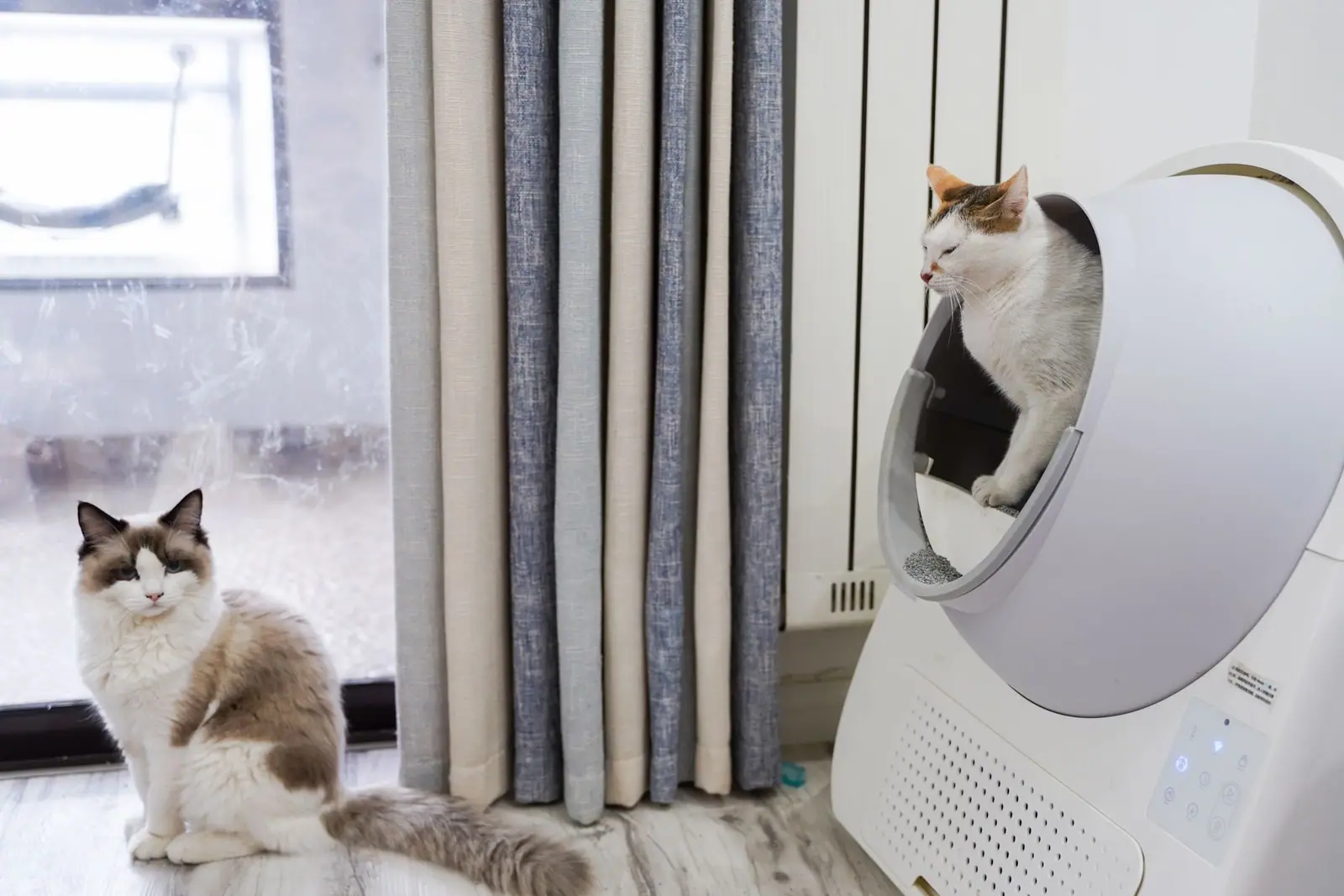
AAHA/AAFP’s litter guidance gives a rule of thumb of one box per cat plus one extra, or per social group plus one extra when social groups are known. Boxes should occupy different accessible locations. A manufacturer’s multi-cat capacity claim addresses operation, not every household’s social access.
The litter box number and placement guide explains why several trays side by side may not offer the same choices as separate locations. A cat can avoid a machine because of the entry, noise, location or another cat blocking access.
Keep a familiar tray available during the transition and follow the manufacturer’s acclimation instructions. Do not force the cat into the robot or remove all existing options simply to make the purchase appear successful. Returning an unused machine is better than continuing with a toilet the cat rejects.
The veterinarian should assess new house-soiling or changes in urination. Straining with little or no urine requires urgent attention. A clean automatic box or an app record cannot rule out a urinary problem.
Waste handling and cleaning remain recurring jobs
The setup guide suggests a typical waste-drawer emptying frequency of twice weekly for two average-sized cats and about weekly for one cat. The product page separately advertises up to eight days in a one-cat household. These are operating examples and claims, not a promise for every cat or litter routine.
Check the drawer and litter level directly. The manufacturer’s guide notes that dark bags can affect waste-level readings. App information is helpful, but incorrect bag installation, a depleted supply or dirty sensors still requires someone to inspect the unit.
Litter compatibility also matters. The guide requires a sifting-compatible material and excludes nonclumping, newspaper-based and wood-pellet materials. The cat litter comparison helps keep the cat’s acceptance alongside the machine’s compatibility, rather than changing litter solely to justify the device.
Add liners, filters, cleaning supplies and possible parts to the ownership worksheet. Do not assume that removing daily scooping removes cleaning or makes an unattended trip safe. A robot is worth considering when it performs a task the household wants to automate and its remaining upkeep, placement and cat access are workable.
Questions people ask
How much is Litter-Robot 4?
Whisker's October 2026 product page lists it from $699. The extension from 1 year to 3 years of warranty is $129; together those listed prices total $828 before tax or other extras.
Does it pay for itself through litter savings?
There is no guaranteed household payback. Measure any change in litter consumption, and compare liners, filters and repairs. Reduced scooping effort can be valuable even without lower cash spending.
Can a small kitten use automatic mode?
The manufacturer's getting-started guide requires at least 3 pounds in automatic mode because smaller cats are not recognized by the weight scale. Follow the model's limits and retain another accessible toilet option.
Can one robot replace every litter box?
A manufacturer's multi-cat claim does not establish sufficient toilet access. AAHA/AAFP advises separate accessible locations and a rule of thumb of one box per cat plus one extra, with social grouping also considered.
Where these figures come from
- Litter-Robot 4 Price, Dimensions and Warranty Whisker · whisker.com
- Litter-Robot 4: Getting Started Whisker Support · litter-robot.com
- General Litter Box Considerations American Animal Hospital Association / AAFP · aaha.org
- Whisker Robots: Trial and Return FAQ Whisker · whisker.com
Figures last checked October 2026.