On this page
An automatic coop door can remove the job of opening and closing one entrance at scheduled times. It does not inspect the flock, count birds inside, refill water or repair a damaged run. The upgrade is easiest to evaluate when those remaining chores are already assigned and the door solves a timing problem.
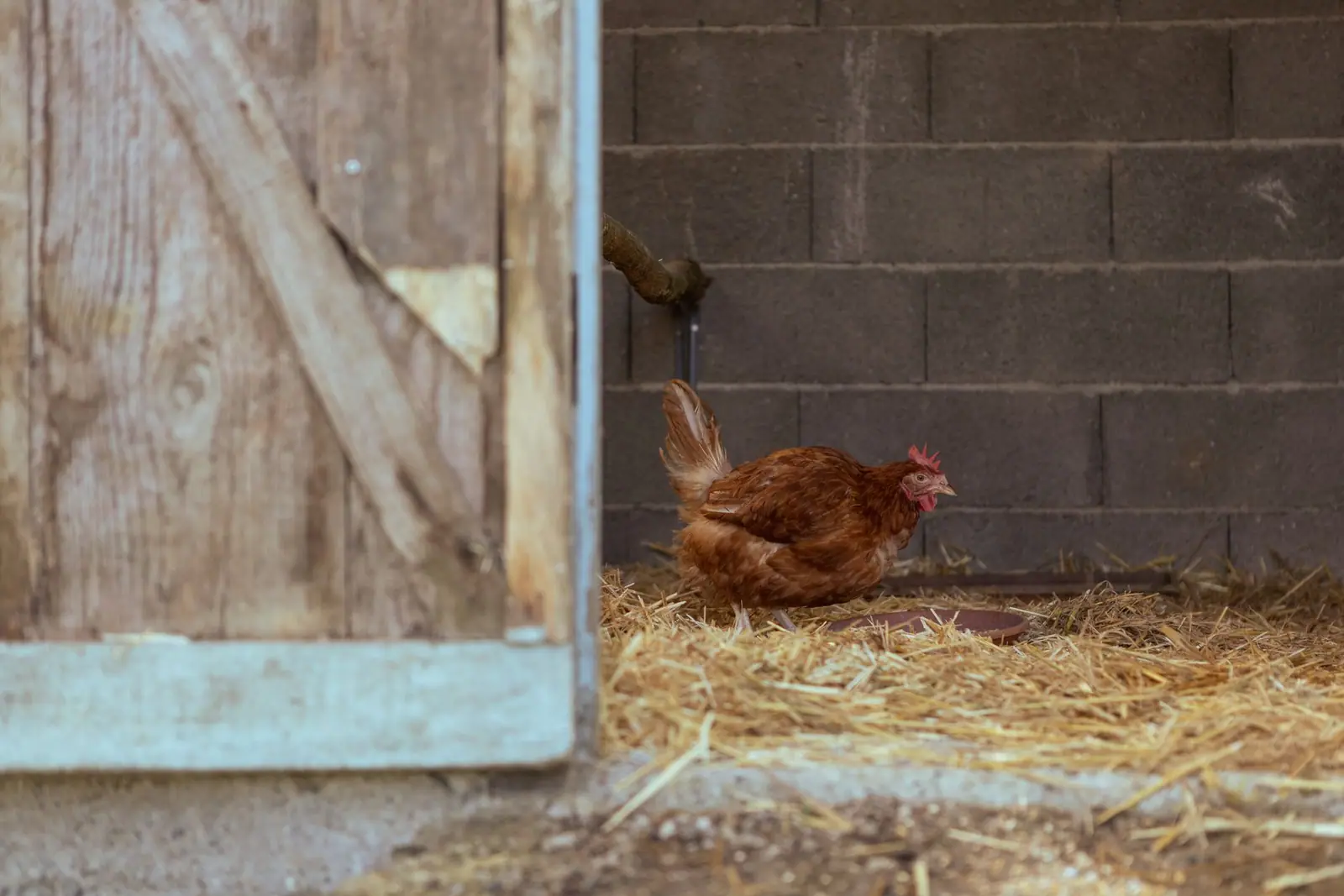
The October 2026 manufacturer examples below distinguish basic, smart and light-equipped products. Prices are for the named hardware, not a national installed range. The cover shows a hen beside a manual wooden doorway, illustrating an existing entrance to assess before a retrofit; it does not show an automatic opener or a priced model.
Key figures
- $199 Omlet non-smart Autodoor
- $229 Omlet Smart Autodoor
- $259 Omlet Smart Autodoor with coop light
Current manufacturer examples start at $199
Omlet’s U.S. page lists multiple products in its current catalog data. Green and gray versions share the prices below. A non-smart door and a Smart Autodoor with remote features should not be treated as the same offer because both can open automatically.
| Manufacturer and configuration | Published price | Difference to evaluate |
|---|---|---|
| Omlet non-smart Automatic Chicken Coop Door | $199 | Basic automatic operation |
| Omlet Smart Automatic Chicken Coop Door | $229 | Smart control and notifications |
| Omlet Smart Autodoor with Coop Light | $259 | Smart door plus the $30 light |
| Smart Chicken Door standard timer model | $320 | Timer door with included AC adapter |
Source note: Omlet’s current U.S. product offers and Smart Chicken Door’s current standard-door variant data, checked October 2026. These prices precede any extra checkout or installation charges; mounting packs and power options can change the order.
- Omlet non-smart Autodoor$199
- Omlet Smart Autodoor$229
- Omlet Smart Autodoor with light$259
- Smart Chicken Door timer model$320
Source note: Omlet's current U.S. product offers and Smart Chicken Door's current standard-door variant data, checked October 2026. These prices precede any extra checkout or installation charges; mounting packs and power options can change the order.
The Omlet smart premium is $30 over the non-smart unit. Adding the light costs another $30, making the light-equipped smart version $60 above the basic one. Decide whether notifications or the timed light solve a real requirement before treating every upgrade as necessary.
The $320 standard timer model from another manufacturer is $91 above Omlet’s $229 smart example, but the products differ in mechanics, power and installation. The price gap alone does not establish reliability or compatibility. Compare the opening, fitting instructions and included supply rather than selecting the cheaper row before measuring.
Installation can add more than the smart premium
For an explicit worksheet, combine the $229 Smart Autodoor with assumed $80 installation and $8 for the initial battery set. The subtotal is $317 before added charges. Installation alone is more than twice the $30 smart premium, so a quote that ignores fitting work can distort the comparison.
If assumed fitting rises to $160, that same subtotal becomes $397. If a quoted existing opening accepts the unit without paid alteration, the hardware-and-battery subtotal is $237. Neither fitting allowance is a contractor rate: replace it with the work needed at the coop.
Ask whether the installer supplies a mounting pack, strengthens the surround, weather-protects exposed parts and tests the opening and closing travel. A unit that fits a wooden wall may need a different fixing kit on mesh. Omlet’s current catalog lists different attachment packs rather than one universal mount.
Smart Chicken Door’s guide specifies an opening 10.25 inches wide and 12 inches high, or coverage of an existing opening. It recommends inside installation; if fitted outside, it says the door needs weather protection. Its included AC adapter is not permission to run an exposed household extension cord across a wet yard.
The predator-resistant coop guide covers the rest of the boundary. Automating one entrance does not resolve weak mesh, digging access or a gap beside a new frame. Price changes to the enclosure separately from the opener itself.
Batteries and Wi-Fi have operating limits
Omlet advertises four AA batteries lasting up to six months on its Smart Autodoor. At that maximum, two sets over twelve months use eight batteries. The phrase up to matters: use, connection behavior and conditions can shorten operation, and a low-battery check belongs in the daily routine.
With an assumed $8 cost for each four-battery set, two sets cost $16 per year. If a household instead needs four sets, that worksheet becomes $32. The $16 difference can exceed a small sale discount over a few years, but neither scenario is a measured battery life or a quoted manufacturer battery price.
The manufacturer says Wi-Fi works best when the coop is within 30 feet of the router and offers optional mains power for increased app responsiveness. Walls and signal conditions can still affect a connection within that distance. Test the site rather than equating a distance label with guaranteed coverage.
Remote notifications report door status, not a verified count of birds inside. If a notification fails, someone still needs a way to inspect the door and flock. Confirm how the model behaves without Wi-Fi or power and where its manual controls can be reached.
A saved trip is not the whole care visit
Suppose opening and closing the entrance alone take a combined two minutes each day. Over 365 days, that is 730 minutes, or about 12 hours 10 minutes. If the same trips are still needed to inspect and care for the flock, much of that time may remain in the routine.
A door priced at $229 therefore has no automatic cash payback for a household performing unpaid chores. It can make timing easier, especially at dawn or when an evening return is delayed. That convenience is different from a reduction in an invoice.
For a hypothetical sitter charging $20 per care visit, eliminating a separate door-only visit for 15 days would save $300 only if the service agreement really removes those visits. If the sitter must still check birds, food and water at those times, the avoided bill is $0. Do not assume the door can replace supervision during an absence.
The chicken sitter budget treats the paid care arrangement separately. The backyard chicken budget includes continuing feed and health costs that door automation does not reduce.
The closing schedule requires observation
Omlet offers timer or light-sensor operation and an obstruction safety sensor. Its separate light switches on five minutes before scheduled closing and off once the coop is shut. Those functions can assist the routine, but the manufacturer does not turn a door sensor into a flock-counting system.
Observe the flock’s return time after installation and when seasons or routines change. Keep the track clear of bedding and check closing travel. A bird remaining outside, a jammed track or a mode left on manual needs a response, even if an app normally reports successful closure.
Smart Chicken Door’s guide explicitly says its door will not operate automatically when left in Manual Run. Its timer mode has its own active indicator and AM/PM display convention. Have the caregiver understand those controls rather than assuming a clock setting means the timer is enabled.
Follow the model’s installation and testing instructions, and keep a person responsible for daily checks and failures. An obstruction sensor cannot make the whole coop predator-resistant or confirm that every hen has returned.
CDC’s backyard-poultry guidance also keeps hygiene in the care routine: wash hands after handling birds or their environment and keep poultry supplies outside food-preparation areas. A motorized door changes none of those duties. Retain the receipt, spare-parts information and instructions so a failure is a repair task with a known model rather than a new search from scratch.
Questions people ask
How much is an automatic chicken door?
The named examples list $199 for Omlet's non-smart door, $229 for its Smart Autodoor, $259 with the light, and $320 for Smart Chicken Door's standard timer model. Fitting, mounts and power options can add cost.
How often will the batteries need changing?
Omlet states four AA batteries for up to six months on its smart model. Actual duration can be shorter; two sets per year is a maximum-duration calculation, not a guaranteed schedule.
Does a closing notification prove all hens are inside?
No. Door status and bird count are different observations. A caregiver still needs to check the flock and respond to birds left out or failed operation.
Can the door replace a chicken sitter?
It handles entrance movement, not food, water, health or enclosure checks. A paid visit saves money only if that visit can truly be removed without leaving those care duties unattended.
Where these figures come from
- Smart Autodoor: U.S. Product Offers and Specifications Omlet · omlet.us
- Automatic Coop Door: Standard Timer Variant Smart Chicken Door · smartchickendoor.com
- Installation and Operating Modes Smart Chicken Door · smartchickendoor.com
- Backyard Poultry: Household Hygiene CDC · cdc.gov
Figures last checked October 2026.