On this page
Bulk feed is economical only when the flock can use it while it remains in good condition and the storage setup keeps moisture and pests out. A lower price per pound cannot compensate for buying more feed than the household can store or use.
The container and feed examples below were checked on the manufacturers’ own sites in October 2026. They illustrate a modest bag-size discount, rather than a national feed-price range. The consumption examples are worksheet assumptions, not feeding instructions for a particular flock.
Key figures
- $49.99 Vittles Vault Outback, nominal 30-pound capacity
- $64.99 Vittles Vault Outback, nominal 50-pound capacity
- $88.99 Scratch & Peck 50-pound layer pellet bag
Storage containers add a purchase cost before any saving
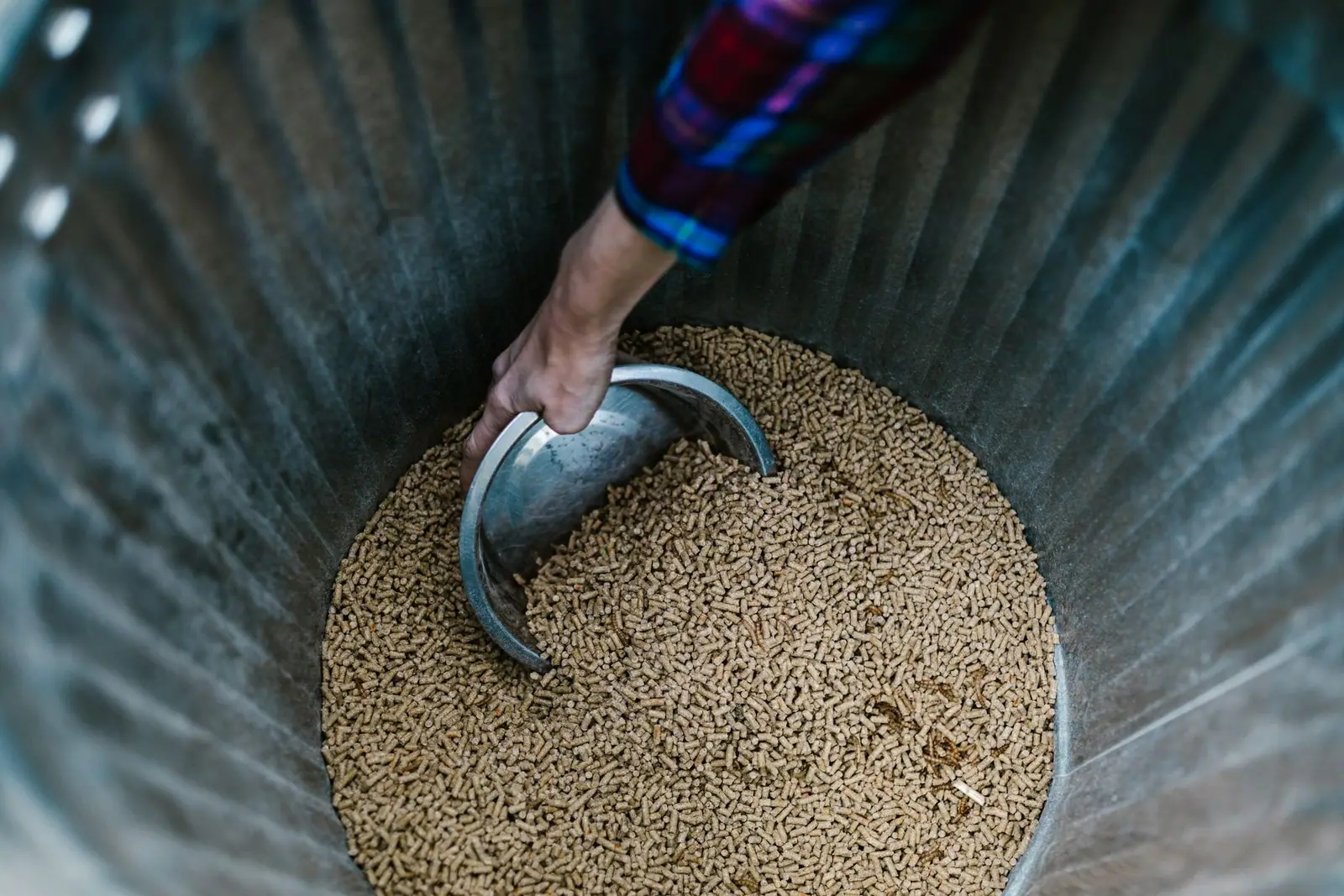
Petmate’s Vittles Vault Outback uses HDPE plastic and a threaded seal with gaskets. The current variants list nominal capacities of 30 and 50 pounds. Petmate warns that the shape and density of the food affect how much fits, and recommends rounding up when uncertain.
| Manufacturer example | Listed price | What the figure covers |
|---|---|---|
| Vittles Vault Outback, nominal 30 pounds | $49.99 | One container |
| Vittles Vault Outback, nominal 50 pounds | $64.99 | One larger container |
| Named organic layer pellets, 25 pounds | $44.99 | Feed bag, before added delivery |
| Named organic layer pellets, 50 pounds | $88.99 | Feed bag, before added delivery |
Source note: Petmate’s Outback product variants and Scratch and Peck’s Organic Layer Pellets listing, checked in October 2026. Capacity is a food-density-dependent guideline, not a guaranteed fit for a particular feed bag inside its original packaging.
The larger container adds $15 to the purchase. Two small containers total $99.98 and provide different separation and access from one $64.99 larger bin. Do not compare them only by nominal pounds: the opening, bag fit, lifting weight and cleaning arrangement matter.
The whole-flock budget separates equipment from feed consumption. A container bought once should not appear as another full purchase every month unless replacements are being planned.
The named large bag saves less than a dollar
The 25-pound feed bag costs $44.99 divided by 25, or $1.7996 per pound. The 50-pound bag costs $88.99 divided by 50, or $1.7798. Two small bags are $89.98, so one large bag saves $0.99 before any difference in delivery or discounts.
That difference is about 1.1% of the two-bag subtotal. It is a real saving at the listed prices, but much smaller than a claim that bulk purchases automatically slash feed bills. A local supplier or a different ration can produce another price relationship; repeat the calculation with the feed the birds eat.
To recover the $15 larger-bin premium solely through that $0.99 bag-size saving would require sixteen 50-pound purchases, or 800 pounds of feed. Fifteen purchases save only $14.85. This conditional payback assumes unchanged prices, equal delivery costs and no loss, and compares the larger bin with the smaller bin already planned.
Buying a $64.99 container solely for the discount would require sixty-six $0.99 savings to exceed its price. That is 3,300 pounds purchased. The container can have other benefits, but those should be described as storage and handling benefits rather than an immediate discount-funded return.
Consumption determines whether a bag fits the storage window
Penn State’s housing guidance recommends a cool, dry, nonsunny feed-storage location and describes a storage period of up to one month. Its small-flock guidance uses four weeks. Sun, heat and moisture can damage feed; an airtight container is not proof of indefinite shelf life.
For a worksheet, assume four birds together consume one pound daily. A 25-pound bag lasts 25 days and a 50-pound bag lasts 50. At an assumed two pounds daily for a larger flock, the same bags last 12.5 and 25 days. Those figures explain purchasing speed, not a recommended ration or intake for every hen.
Over 28 days, the one-pound daily example uses 28 pounds, while the two-pound example uses 56. The smaller flock’s storage plan therefore has a different bag-size question from the larger flock’s, even if both own an identical container.
Use the chicken feeding guide for diet context. Measure the household’s purchasing and waste pattern rather than reducing the ration merely to make a large feed purchase last longer.
Small losses erase a modest bulk discount
At the named large-bag price, one wasted pound represents about $1.78, already exceeding the $0.99 saving. If five pounds of a 50-pound bag are lost, $8.90 of purchased feed is wasted. The remaining 45 usable pounds then cost $88.99 divided by 45, or about $1.98 each.
That effective price is higher than the small bag’s $1.7996 per pound, even before the new container. The loss scenario is hypothetical; it shows why keeping feed dry and buying manageable amounts can matter more than a small bag discount.
Do not mix a new batch into an old remainder without preserving the batch information and checking the bin’s condition. Keep the product label, lot and date available. They matter if there is a recall, a diet question or an unexplained change in feed condition.
If the original bag fits in the container, keeping it can help retain that information. If feed is transferred, save the labeling separately and mark the contents. A bin labeled only “chicken feed” does not distinguish starter, grower and layer rations or their batch histories.
Cleaning and handling determine which container works
Petmate recommends regularly washing and drying the container and notes that oils can accumulate in plastic. Allow the container to dry before refilling it. Check the seal and opening as well as the main wall: a lid left loose defeats part of the storage arrangement.
The manufacturer describes indoor or covered outdoor use and recommends climate-controlled storage. A plastic bin exposed to afternoon sun and rain is not the same setup. Penn State also discusses metal cans for protecting stored feed and supplies from rodents; choose a storage plan that fits the property’s pest pressure rather than assuming every material performs identically.
Lifting a 50-pound bag can be harder than handling two 25-pound bags, and a deep bin may make the last feed difficult to reach. Price a manageable location and scoop without compromising dry storage. An assumed $8 scoop added to the $64.99 container gives $72.99 in equipment, before the first bag.
Do not feed moldy or contaminated feed to avoid a financial loss. Maintain the storage conditions and age-matched ration specified for the flock. Seek poultry veterinary guidance if illness or a feed-related problem is suspected.
For the final decision, compare the delivered feed prices, the rate of use and the cost of storage already owned. The chick versus pullet comparison explains why growing birds can also change which ration is purchased. A discount on layer pellets does not make them a substitute for the feed required by younger birds.
Questions people ask
Is the 50-pound feed bag always cheaper?
The named bags save $0.99 when one $88.99 large bag replaces two $44.99 small bags, before delivery. Other feeds and sellers can have a different discount.
Will a 50-pound container hold every 50-pound feed bag?
Not necessarily. Petmate says capacity depends on food shape and density. The original bag and opening also affect fit; check the container with the feed and handling arrangement being used.
How long should feed stay in storage?
Penn State describes cool, dry, shaded storage for up to a month and uses four weeks in its small-flock guidance. Follow the feed label and conditions rather than treating a sealed bin as an indefinite freshness guarantee.
How much waste removes the named bulk saving?
One pound at the large bag's unit price costs about $1.78, more than the $0.99 discount. Even a small loss can make the larger purchase more expensive per usable pound.
Where these figures come from
- Vittles Vault Outback: Prices, Capacity and Care Petmate · petmate.com
- Organic Layer Pellets: 25- and 50-Pound Prices Scratch and Peck Feeds · scratchandpeck.com
- Small Scale Poultry Housing: Feed Storage Penn State Extension · extension.psu.edu
- Successfully Raising a Small Flock: Four-Week Storage Penn State Extension · extension.psu.edu
Figures last checked October 2026.